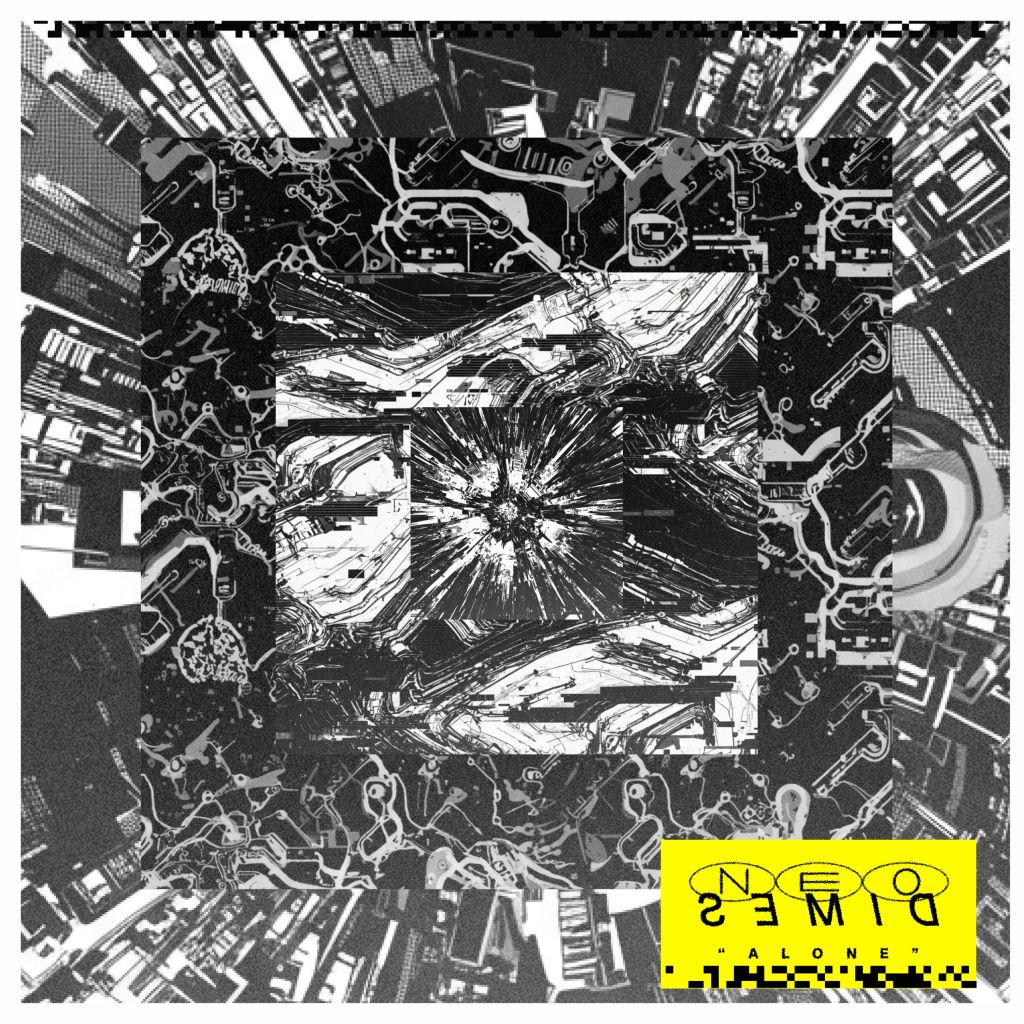
Neo Dimes is the musical identity of Denver-based musician Stephen Edmunds, an artist unafraid to confront the social ills of the digital age through both sonic experimentation and lyrical directness. Reflecting that vision, his debut full-length album Alone functions as both a critique of modern music consumption and a compelling artistic statement in its own right.
The ten-track record opens with Beast, a song that immediately evokes the industrial tension of Nine Inch Nails and Skinny Puppy. At the same time, the urgency of the vocals and the underlying darkness reminded me of early Linkin Park. Despite its bleak themes and atmosphere, the track never loses its sense of melody, maintaining a surprisingly catchy edge.
The second song, Angels, continues many of the album’s themes. Its lyrics seem to reflect life in a highly personalized digital world, where our attention is constantly manipulated by forces designed to capture it. While the song acknowledges the power of these distractions, it ultimately arrives at a more hopeful conclusion, suggesting that some protective force – whether spiritual, emotional, or personal – can help keep us grounded. Musically, the track is driven by a powerful bassline that occasionally brought early Placebo to mind, while retaining the accessibility and immediacy that runs throughout the album.
The album’s longest track, God’s Perfect Meme, serves as one of its thematic centerpieces. The lyrics read as a dark, satirical commentary on modern culture, misinformation, social media, politics, and mass psychology. The narrator appears aware of their own participation in a system of deception while criticizing a society that has become too distracted, cynical, or exhausted to challenge it.
Musically, one of my personal highlights is Trigger, a highly energetic track with a distinctly synth-pop flavour. Its atmosphere sits somewhere between the soundtrack to Drive and Depeche Mode, combining retro textures with a modern sense of momentum. The song builds beautifully throughout its runtime and features an extended instrumental passage that works particularly well.
Don’t Think leans heavily into a Nine Inch Nails-inspired industrial sound, delivering one of the album’s darker and more abrasive moments while remaining surprisingly accessible.
In the second half of the album, another standout is One Thing. At over six minutes long, it manages to stay engaging thanks to its infectious energy, memorable melodies, and exceptional production. The song gradually evolves and intensifies while embracing a repetitive structure that works to its advantage. Some of the melodic choices even carry a subtle Duran Duran-esque quality, reinforcing the album’s occasional affection for 1980s synth-pop.
That influence becomes even more apparent on How to Love, arguably the album’s ultimate 80s-inspired anthem. Built around a pulsing rhythm, the song combines shimmering synths with acoustic guitar flourishes that add warmth and texture. As the arrangement expands, the vocals become increasingly emotional and uplifting. “Can you show me how to love / Can you teach me how to trust / When I’m not strong enough / And weakness comes / Can you carry us,” Edmunds sings, introducing a sense of hope that gradually emerges from the album’s darkness.
With It Comes and Goes and the closing track Dear Ghosts, that hopeful feeling continues to grow. By the end of the record, the atmosphere has shifted noticeably toward the light. What begins as an exploration of alienation, manipulation, and uncertainty ultimately becomes something more optimistic. It is this balance between darkness and hope that makes Alone such a rewarding listen.
This album was discovered via Submit Hub



 motel void
Leave a comment